
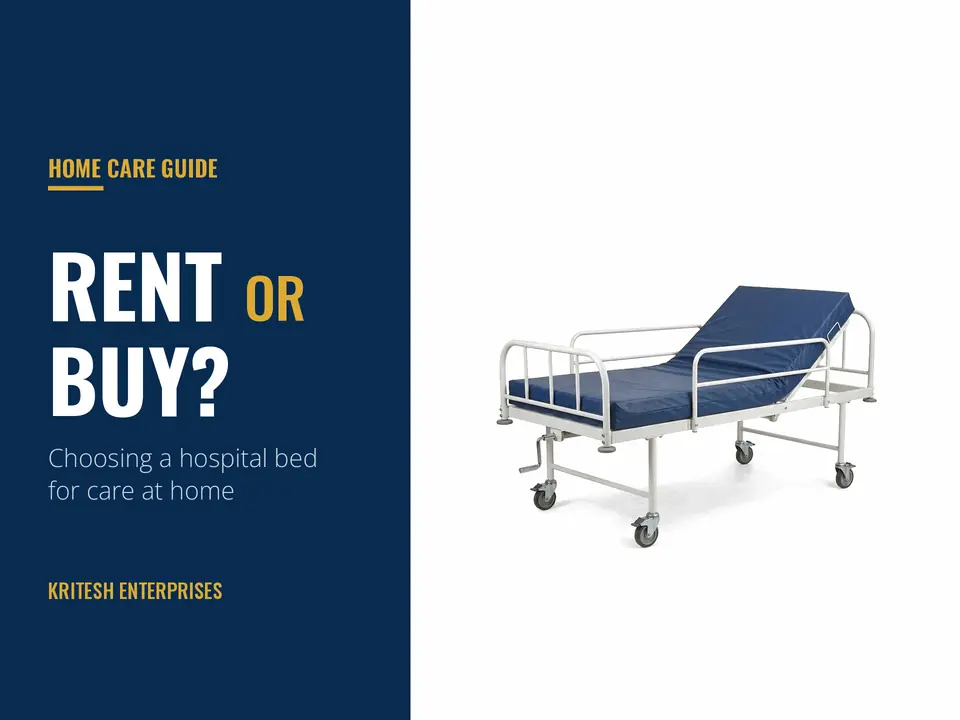
When a doctor says a patient can go home but will need a hospital bed, families usually have a day or two to arrange one. The first question is almost always the same: should we take a hospital bed on rent, or buy one?
The right answer depends less on price alone and more on three things: how long the bed will be needed, what the patient's condition requires, and who will be caring for them at home. This guide explains the trade-offs of hospital bed on rent vs buying, gives a simple way to compare costs using real quotations, and lists the features and safety points to check before the bed arrives. It is written for families in Dombivli, Kalyan, Thane, Mumbai and Navi Mumbai, but the steps apply anywhere.
Why a hospital bed helps in home care
An ordinary bed is low, flat and fixed. A hospital bed for home use, often called a Fowler or semi-Fowler bed, lets you raise the back and knee sections, and on some models the height of the whole bed. That makes daily care easier:
- Sitting the patient up to eat, take medicines or rest more comfortably
- Turning and repositioning patients who cannot move on their own; UK public health guidance advises turning patients who need help at least every 2 hours to help prevent pressure sores
- Less bending and back strain for caregivers during sponge baths, diaper changes and dressings
- A firmer handhold, through the side rails, when getting in and out of bed
Whether a patient needs a hospital bed, and which features matter, is a decision for the treating doctor, nurse or physiotherapist. The rest of this guide helps you act on that advice.
Renting a hospital bed: when it makes sense
Taking a hospital bed on rent usually suits families whose need is short-term or uncertain.
Advantages of renting
- Low upfront cost: you pay a monthly rent instead of the full purchase price.
- Quick set-up: the rental provider delivers and installs the bed, often within a short time when stock is available.
- Flexibility: if the patient's needs change, for example from a manual bed to a motorised bed, you can ask to switch models.
- Nothing to store later: when recovery is complete, the bed goes back. This matters in city flats where space is tight.
- Support during the rental: many providers handle servicing while the bed is with you; confirm this before you book.
Limitations of renting
- Monthly rent adds up if the need stretches over many months.
- Rental beds are pre-used, so ask how they are cleaned, sanitised and checked between patients.
- A specific model may not always be available at short notice.
Renting suits: recovery after a hip or knee replacement, fracture or major surgery; a short illness; a trial period while you decide whether to buy; and situations where the family cannot yet predict how long care will continue.
Buying a hospital bed: when it makes sense
Buying a hospital bed for home use is usually the better choice when care will continue for a long or open-ended period.
Advantages of buying
- Lower cost over a long period: after a certain number of months, total rent overtakes the purchase price.
- A new bed of your choice: you select the exact model, functions and mattress.
- Always available: the bed stays with the family and can be used again if another member needs it.
Limitations of buying
- A higher upfront payment.
- Servicing after the warranty period becomes your responsibility.
- You need space for the bed, and you will need to store, sell or dispose of it later.
Buying suits: elderly family members who are mostly bed-bound, long-term paralysis, progressive neurological conditions, and other situations where the doctor expects long-term home care.
Hospital bed on rent vs buying: side-by-side comparison
| Factor | Renting | Buying |
|---|---|---|
| Expected duration of need | Short-term or uncertain | Long-term or permanent |
| Upfront cost | Low (monthly rent, plus any deposit) | High (full purchase price) |
| Total cost over a long period | Rises every month | Fixed after purchase |
| Changing the bed type | Usually possible | Requires a new purchase |
| Maintenance | Often handled by the provider | Your responsibility after warranty |
| Condition of the bed | Pre-used, sanitised | New |
| After care ends | Returned to the provider | Stored, sold or given away |
How to decide: a four-step check
Step 1: Ask the doctor how long the bed is likely to be needed
This is the single most useful question. As a rough guide, if the expected need is a few months, lean towards renting. If it is open-ended or likely to run beyond a year, lean towards buying. If it falls in between, the cost check in Step 3 will help.
Step 2: Decide which type of bed the patient needs
- Manual beds are adjusted with hand cranks. A 2-function bed raises the back and knee sections; a 3-function bed also adjusts the height. They suit patients with a caregiver nearby at most times.
- Electric (motorised) beds are adjusted with a remote. Some patients can adjust their own position, and they reduce effort for a single caregiver or a heavier patient.
- Air mattress: for patients who cannot move much, a pressure-relieving mattress is often advised. Pressure sore prevention works best as a combination of pressure-relieving surfaces, regular skin checks, repositioning, moisture care and good nutrition. Ask the nurse or doctor whether one is needed.
Step 3: Run a simple break-even check
Collect two quotations for the same bed model and mattress, one for rent and one for purchase. Then work out:
Break-even months = purchase price ÷ monthly rent
If the expected need is shorter than the break-even figure, renting usually costs less. If it is longer, buying usually costs less. Add delivery, installation, deposit and accessories to the comparison, and remember that a purchased bed may have some resale value.
For example: if the purchase price is ten times the monthly rent, the break-even point is about ten months. Use the figures from your own quotations, as they vary by model and provider.
Step 4: Check your home and caregiving set-up
- Measure the room, doorways and lift. A hospital bed is longer and often taller than a single bed.
- Leave space on both sides so caregivers can turn the patient and reach the bed safely.
- Place it near a power point if you choose an electric bed, and ask what happens during a power cut.
- Think about who will care for the patient day to day. If family members work, home nursing or a patient attendant may matter as much as the bed itself.
Safety checks before the bed arrives
Whether you rent or buy, ask the provider to install the bed and show you how to use it. Then check these points:
- Side rails and mattress fit: the US Food and Drug Administration warns that patients can become trapped between the rail and the mattress. Use a mattress of the correct size and keep gaps small.
- Rails are not restraints: bed rails are meant to help with moving and repositioning, not to hold a patient in bed.
- Low position and locked wheels: keep the bed at a low height when the patient is resting, with the castor brakes locked.
- Smooth operation: on a rental bed, check that cranks or motors move smoothly, brakes hold and the mattress is clean and intact.
A hospital bed supports care at home; it does not replace medical supervision. Follow the treating doctor's advice on positioning, mattress type and nursing care.
Hospital bed on rent in Dombivli, Kalyan, Thane, Mumbai and Navi Mumbai
Kritesh Enterprises has supplied medical equipment and home healthcare support for almost 10 years. We rent out manual and motorised hospital beds, and the rental period follows your requirement, with no fixed minimum. We serve families in Mumbai, Thane, Navi Mumbai, Dombivli and Kalyan. If you are thinking of buying instead, tell us what the patient needs and we will help you compare.
Alongside the bed, we can also arrange home nursing, patient attendants and doctor home visits. Bed models and stock change, so we confirm current availability and share a personalised quotation when you enquire. For other equipment, see our guide to medical equipment on rent.
Frequently asked questions
Is it better to rent or buy a hospital bed for home use?
Rent if the need is short-term or uncertain; buy if the doctor expects long-term care. For anything in between, compare the purchase price with the monthly rent using the break-even check above.
How many months of renting equals the cost of buying?
Divide the purchase price by the monthly rent for the same model. The result is the number of months after which buying usually becomes cheaper.
Can I rent a hospital bed for just one month?
Many providers offer short rentals. At Kritesh Enterprises, the rental period is as per your requirement, with no fixed minimum.
Should I choose a manual or electric hospital bed for an elderly parent?
A manual bed suits patients with a caregiver nearby most of the time. An electric bed helps when the patient wants to adjust their own position or when one caregiver handles most of the care. Ask the doctor or physiotherapist which functions are needed.
Do I need an air mattress with a hospital bed?
Patients who cannot move much are at higher risk of pressure sores, and a pressure-relieving mattress is often part of prevention. The treating doctor or nurse should advise whether one is needed.
Can I buy the bed later if I start by renting?
Policies differ between providers. Ask at the start whether any rent paid can be adjusted against a later purchase.
Choosing the right option
The choice between a hospital bed on rent and buying one comes down to duration, the patient's needs and your home set-up. Start with the doctor's estimate of how long the bed will be needed, choose the right bed type, run the break-even check with real quotations, and make sure the bed is installed safely.
Need help choosing? Call or WhatsApp Kritesh Enterprises on +91 95945 34316 (Monday to Sunday, 10 am to 8 pm), or send an enquiry. We will check current availability and share a personalised quotation.